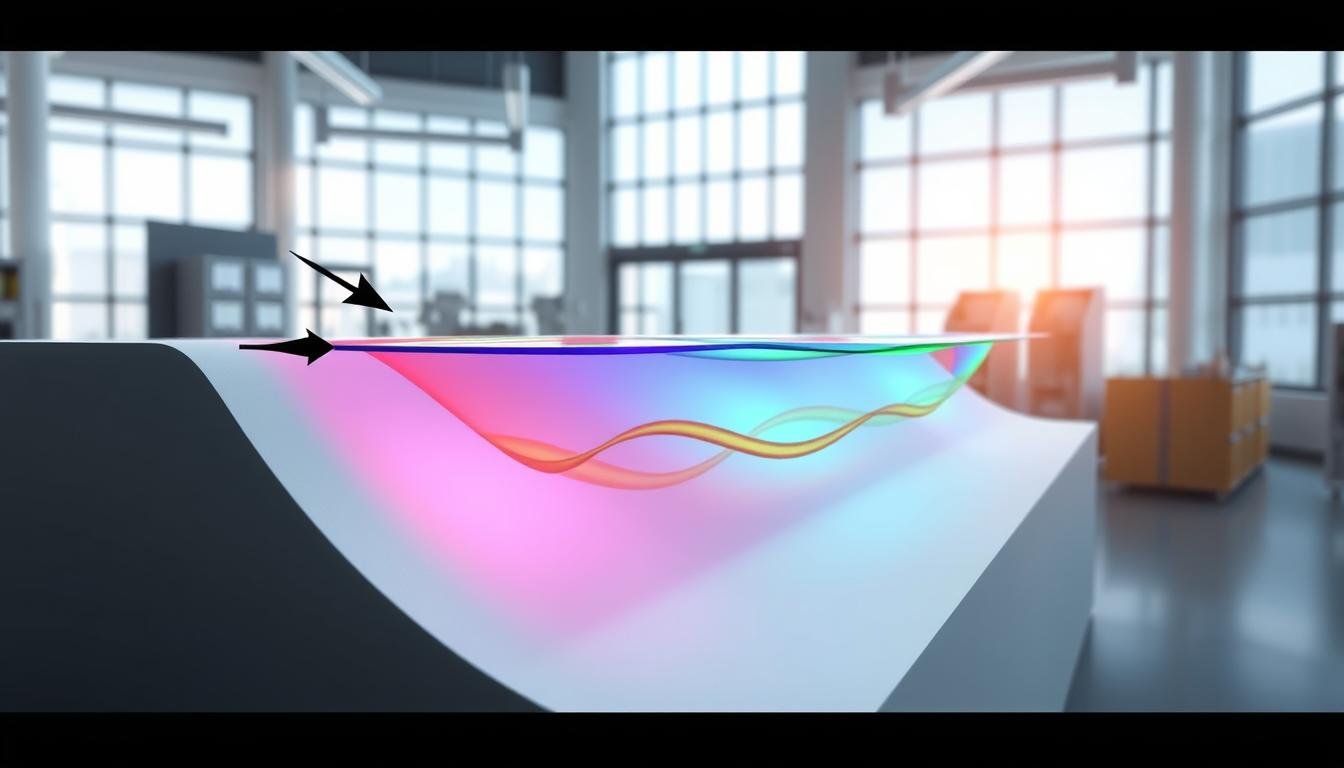
In today’s fast world, precision is key. Engineers in the UK use advanced fluid dynamics to make sure projects are safe. Shear stress transport is a key concept here.
Learning about these forces helps engineers make structures better and more efficient. It’s important for designing things like aerospace parts or buildings. Knowing how these forces work is a must for success.
This knowledge lets teams spot problems before they happen. It’s a critical skill for improving design methods. Let’s see how these ideas shape the future of industry.
Key Takeaways
- Mastering fluid dynamics is essential to optimise structural designs.
- Engineers use these principles to improve safety in industrial projects.
- Predicting force behaviour helps to minimise possible mechanical failures.
- Professional analysis remains a cornerstone of modern British engineering.
- Understanding these concepts ensures better performance across various applications.
What is Shear Stress Transport?
Ever wondered how engineers model air or water forces? They use shear stress transport. It’s key for predicting fluid behavior against solid surfaces. This helps make designs safer and more efficient for many industries.
Definition and Explanation
This method is a complex form of turbulence modeling. It blends different math techniques to show how flow changes near surfaces and in open streams. This method is very accurate in complex settings where simpler methods fail.
Check Ministry Of Transportation here
Engineers use these models to figure out fluid friction and pressure. Turbulence modeling helps them deal with fluid motion’s unpredictability. This makes sure designs can handle real-world pressures without failing unexpectedly.
Importance in Engineering Applications
Shear stress transport is essential in modern engineering. It’s used for designing fast trains or complex cooling systems for power plants. Without these calculations, predicting how structures handle fluid pressure over time would be hard.
The table below shows how different flow types affect design choices:
| Flow Type | Primary Challenge | Design Focus |
|---|---|---|
| Laminar Flow | Low energy loss | Surface smoothness |
| Transitional Flow | Unpredictable shifts | Stability margins |
| Turbulent Flow | High energy dissipation | Structural integrity |
By using these insights early in design, teams can significantly reduce mechanical fatigue risks. This saves time and money, ensuring safety in the UK and worldwide.
The Role of Shear Stress in Fluid Dynamics
At the heart of fluid dynamics is the complex interaction between moving layers of matter. When a fluid flows over a surface, it faces internal resistance. This resistance, known as shear stress, is key for engineers to understand how liquids and gases behave.
Shear Stress in Newtonian and Non-Newtonian Fluids
Not all fluids react the same to force. Newtonian fluids, like water or air, have a constant relationship between shear stress and deformation. This predictable behaviour makes it easier for engineers to use simple models for most applications.
On the other hand, non-Newtonian fluids, such as paints or blood, are more complex. Their viscosity changes with the force applied. Understanding these changes is crucial for industrial processes where fluid consistency is key for quality and equipment life.
Relationship with Fluid Velocity and Viscosity
The link between velocity and viscosity is explained by boundary layer theory. As a fluid moves over a solid, its velocity drops to zero at the surface due to friction. This creates a thin area where velocity changes quickly, making shear stress intense.
Viscosity is like the “glue” that resists layer sliding. By applying fluid dynamics principles, we can figure out the energy lost to friction. This knowledge helps design efficient pipelines, wings, and turbine blades for high-speed flow.
Calculating Shear Stress in Various Materials
Getting precise with stress analysis is key when dealing with complex materials. Engineers need to know how parts behave under stress to ensure they are safe and last long. They use detailed math to spot where things might break before they start building.
Formulas and Methods for Calculation
To find shear stress, you look at the force and the material’s area. With fluids, you also need to think about viscous flow. This makes sure the fluid’s internal resistance is right in the model.
For simple cases, engineers use τ = F/A. Here, τ is shear stress, F is the force, and A is the area. But for fluids and viscous flow, you add in things like viscosity and how fast the fluid moves. This keeps structures strong in different settings.
Examples of Shear Stress Calculation
Imagine a steel beam in a bridge under a lot of weight. Engineers do a stress analysis to figure out the shear force. This checks if the beam can handle the load without bending.
In pipeline design, fluid moving inside creates friction. Engineers work out the shear stress to stop the pipe from wearing out. Accurate data helps pick materials that can handle the wear and tear.
The ability to quantify internal forces is the cornerstone of modern engineering excellence.
Key Factors Influencing Shear Stress Transport
Fluids don’t always move in a straightforward way. Engineers need to understand how various factors affect energy movement. This knowledge helps spot weak points and make designs last longer.
Material Properties and Their Impact
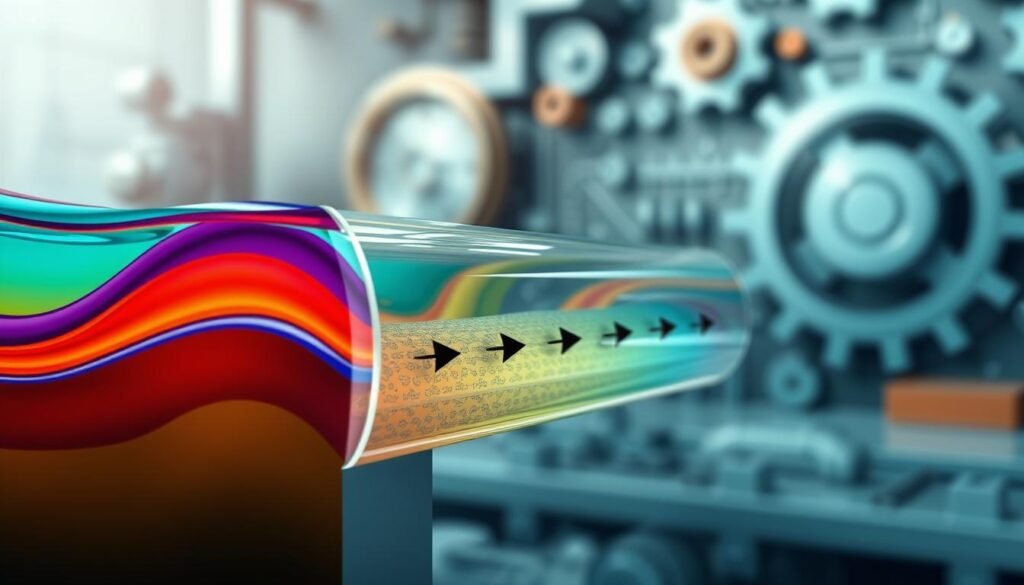
The material’s physical properties are very important. Things like viscosity and surface roughness affect how layers move. A rough surface can make flow harder, leading to more energy loss.
Fluid density also matters a lot. Boundary layer theory shows that the area near a solid surface changes the most. Knowing these details helps predict stress distribution better.
Environmental Conditions and Flow Characteristics
Things like temperature and pressure can change how fluids behave. Higher temperatures can make fluids less viscous, altering shear stress transport. These changes are key to keeping structures safe.
The type of flow is also very important. Laminar flow is steady, but turbulent flow is full of unpredictable eddies. Understanding this helps engineers design for the unexpected.
| Flow Type | Stress Distribution | Predictability |
|---|---|---|
| Laminar | Uniform and steady | High |
| Transitional | Variable | Moderate |
| Turbulent | Highly irregular | Low |
Looking at these flow types shows why turbulent flow is more challenging. Engineers who consider these differences can better prevent failures. Keeping a close eye on these factors is essential for reliable engineering.
Applications of Shear Stress Transport in Engineering
Engineering needs a good understanding of how fluids move and affect solid structures. By studying these effects, experts can spot problems before they happen. This helps keep buildings and systems safe and working well for a long time.
Structural Engineering and Material Selection
In structural engineering, picking the right materials is paramount for success. Engineers must choose materials that can handle constant stress from the environment. Fluids pushing against surfaces can wear them down if the material is not right.
To avoid damage, designers look for certain qualities in materials:
- High fatigue resistance to handle repeated stress.
- Corrosion-resistant coatings to lower surface roughness.
- Thermal stability to keep strong under changing temperatures.
Shear Stress in Pipeline Design and Maintenance
Pipeline networks are key for modern industries, moving essential goods over long distances. A big worry for engineers is managing frictional forces between the fluid and the pipe. These forces affect how much energy is needed for transport and how long the system lasts.
Designing these systems means considering a few things:
- Working out the exact effect of frictional forces on pressure inside.
- Setting up regular maintenance to remove debris that increases drag.
- Using advanced tools to spot early signs of pipe thinning.
By balancing these aspects, engineers make sure pipelines can handle high-pressure fluids safely. Controlling frictional forces is not just about saving energy; it’s essential for avoiding big leaks and keeping the environment safe.
Shear Stress Transport in Civil Engineering Projects
The earth’s hidden forces are key to every big construction project’s success. Engineers designing foundations must think about soil layers and structural elements. By controlling frictional forces, teams keep buildings stable under heavy loads.

Importance in Foundation and Soil Mechanics
Soil mechanics is critical for safe building. A site’s load-bearing capacity relies on the ground’s resistance to change. When a foundation is built, frictional forces between soil and concrete stop the structure from moving or sinking.
Engineers use complex models to forecast these forces over time. If the soil is too loose, failure risks rise. So, correct soil compaction and material choice are key to keeping structures strong.
Case Studies: Successful Applications
Real projects show the importance of managing shear stress. For example, the Shard in London needed detailed analysis of clay layers. By figuring out frictional forces at the pile-soil interface, the team made sure the tower could handle huge loads.
The Thames Barrier is another example. Engineers had to deal with complex riverbed conditions to stop erosion and foundation movement. Thanks to creative design, they managed water flow’s impact on soil, showing shear stress’s role in lasting strength.
Challenges and Limitations in Shear Stress Transport
Getting precise in shear stress calculations is a big challenge for today’s engineers. Theoretical models are a good start, but real-world issues are hard to measure. Knowing these problems helps make designs safer and more efficient.
Common Issues in Measurement and Calculation
Turbulent flow is very unpredictable. Fluid particles move in chaotic ways, making it hard to use simple equations. This makes it tough to get accurate data during tests.
Also, sensors have their limits. They might not work well under high pressure or fast changes. Engineers often have to use approximations, which can lead to big errors.
Mitigating Risks and Enhancing Accuracy
To tackle these problems, a multi-step approach to checking data is needed. It’s not enough to rely on one source, as turbulent flow is complex. By comparing test results with computer models, any mistakes can be found early.
Using robust simulation software is also key. It lets teams test ideas safely in a digital space. This way, they can tweak parameters until the model matches real-world data well.
Lastly, keeping an eye on things during use is very helpful. By watching data in real-time, engineers can plan maintenance better. This helps prevent turbulent flow from damaging the system over time.
Advances in Shear Stress Transport Research
Modern engineering is seeing a big change in how we study fluid behaviour. Scientists are finding new ways to improve shear stress transport research. This is helping them get more accurate results.
Innovations in Measurement Techniques
New sensor technology has changed how we collect data. High-speed imaging and laser diagnostics let researchers see flow patterns clearly. These tools give us a closer look at what happens in fluids.
With these advanced tools, engineers can check their theories against real data. This link between theory and practice is key for safer, more efficient designs. Here’s a table showing how these diagnostic methods have evolved.
| Methodology | Precision Level | Primary Benefit |
|---|---|---|
| Traditional Pitot Tubes | Moderate | Cost-effective |
| Laser Doppler Anemometry | High | Non-intrusive data |
| Digital Particle Image Velocimetry | Very High | Full-field mapping |
Future Trends and Expectations in Engineering
The future of engineering will focus on combining turbulence modeling with automated design. As computers get more powerful, we’ll see more detailed simulations. This will help create stronger designs in aerospace and civil engineering.
Data-driven approaches are also changing the industry. By using machine learning with shear stress transport, engineers can spot problems before they happen. This is important for keeping big projects safe.
Improving turbulence modeling is a big goal for researchers. We expect these digital advances to lead to smarter, greener engineering in the next decade. The goal is to make systems that are strong and efficient under different conditions.
Tools and Software for Shear Stress Analysis
Advanced software has changed how experts handle stress analysis. It has made solving complex problems faster and more reliable. These digital tools give the accuracy needed for modern structures and systems to work well under different loads.
Overview of Popular Engineering Software
Many top tools are key for fluid dynamics work. ANSYS Fluent is known for its ability to model turbulent flows and complex layers. OpenFOAM, on the other hand, is open-source and very flexible for custom simulations.
COMSOL Multiphysics is great for combining fluid flow with heat or structural mechanics. These tools offer detailed features to see how materials act in real situations. The right tool depends on the project’s needs and the level of detail wanted.
Benefits of Digital Simulation in Shear Stress Studies
The main benefit of computational fluid dynamics is quick testing before building starts. It lets designers spot problems early. This digital work can greatly cut costs by avoiding physical prototypes and waste.
Also, these simulations make projects safer by revealing hidden stress spots. Engineers can test extreme conditions safely. Using computational fluid dynamics ensures designs are both efficient and durable.
Conclusion: The Future of Shear Stress Transport in Engineering
Modern engineering needs a deep understanding of forces on structures and materials. This knowledge keeps bridges, pipelines, and foundations safe under pressure.
Synthesising Core Principles
Successful projects rely on applying physical laws to real-world problems. Engineers use accurate data to design structures that last. Using computational fluid dynamics early in a project helps spot risks before construction starts.
Driving Innovation Through Discovery
The industry must keep investing in research to solve complex problems. New software and testing methods help teams overcome current limits. These digital advances keep the sector leading in safety standards.
Share your thoughts on how these methods shape your work. Or, reach out to our team to discuss your next big project.