

In the fast-changing world of digital broadcasting, knowing the basics is key for UK media pros. Transport streams are at the core, helping deliver top-notch content to viewers everywhere.
These data structures make sure audio, video, and extra details arrive together perfectly. By getting to grips with these tech basics, broadcasters can better manage their systems. This leads to a much better viewing experience for everyone.
Whether it’s terrestrial signals or satellite feeds, transport streams are the go-to choice. Getting to know them helps teams work smarter and stay ahead in our digital broadcasting world.
Key Takeaways
- Transport streams provide the essential framework for reliable media delivery.
- Proper management of these data packets ensures seamless synchronisation for viewers.
- UK broadcasters must prioritise these standards to maintain high-quality service levels.
- Understanding this infrastructure helps teams better organise their technical resources.
- Reliable distribution remains a cornerstone of successful modern television operations.
What Are Transport Streams?
At the heart of every seamless television broadcast lies a sophisticated method for packaging digital information. Transport streams serve as the invisible engine powering the vast majority of today’s professional broadcast networks. They ensure that data reaches its destination intact.
Definition of Transport Streams
A transport stream is a standard digital container format designed to carry audio, video, and metadata. It is engineered to function effectively over unreliable media, such as satellite links or cable networks where signal loss can occur.
By breaking data into small, manageable packets, this format allows for robust media delivery. Even if some packets are lost during transmission, the system is designed to maintain the integrity of the overall broadcast.
“The beauty of a well-architected transport stream lies in its ability to turn chaotic digital noise into a perfectly synchronised viewing experience for the end user.”
Importance in Broadcasting
Broadcasters rely on these streams to ensure that high-quality media delivery remains consistent, even when network conditions fluctuate. Without this structured approach, maintaining the precise timing required for live television would be nearly impossible.
The primary strength of transport streams is their capacity to keep audio and video perfectly synchronised in complex environments. This reliability is what allows UK broadcasters to provide the high standards of service that audiences expect today.
The Structure of Transport Streams
To understand how your favourite shows get to your TV, we need to look at transport streams. This digital system is key for handling today’s broadcasting needs with great accuracy.
It breaks down information into smaller parts. This ensures audio and video stay in sync. It’s vital for a smooth viewing experience on any device.
Elementary Streams
At the start, we have elementary streams. These are the raw, encoded parts of a broadcast signal, like audio or video.
Before sending out, these streams get packetised. This initial stage is critical for getting the data ready for its network journey.
Stream Multiplexing
Then, stream multiplexing kicks in. It combines multiple channels into one signal.
This method boosts bandwidth efficiency. It helps your TV get a steady feed without breaks.
Header Information
Each data piece has a container with header info. These headers guide the receiver, showing what’s in each data packet.
They also hold error correction data. This lets the receiver fix small problems, keeping the signal clear and accurate.
| Component | Primary Function | Technical Role |
|---|---|---|
| Elementary Stream | Raw Media | Source encoding |
| Multiplexing | Data Combination | Bandwidth management |
| Header Info | Packet Identification | Signal integrity |
| Error Correction | Data Recovery | Reliability |
The teamwork of these parts makes digital broadcasting reliable. By managing data packets well, the industry keeps delivering top-notch content to UK homes.
How Transport Streams Work
Turning raw material into a broadcast signal is a complex process. It ensures top-quality content reaches UK viewers smoothly. By handling transport streams well, broadcasters keep their service high.
Encoding and Compression
The first step is making raw video digital. Broadcasters use video compression to make files smaller but keep quality high. This is key because big video files can’t be sent easily.
Then, the video is split into data packets. These packets are arranged so they can be put back together perfectly. Efficiency is key to send high-definition content without problems.
Transmission Methods
After encoding, content is sent through different networks. Broadcasters use strong data packets for terrestrial, satellite, and cable networks. Each needs special protocols to keep the signal strong and clear.
For example, satellite transmission needs error correction for signal issues. Cable and terrestrial networks aim for high bandwidth to handle many transport streams at once. Reliability is the main goal, so viewers get a smooth experience wherever they are.
Role of MPEG in Transport Streams
The Moving Picture Experts Group (MPEG) plays a key role in broadcasting. They set global standards for transport streams. This ensures that different devices can work together smoothly.
Overview of MPEG Standards
MPEG’s standards are vital for digital TV growth. They guide how audio and video data are sent over networks. This is key for stream multiplexing, combining channels into one signal.
Without these standards, digital TV would be chaotic. Broadcasters use them to keep quality high and manage complex transmissions. This standardisation lets your TV decode signals easily, no matter the source.
MPEG-2 vs MPEG-4
The move from MPEG-2 to MPEG-4 is a big step forward. MPEG-2 was good for early digital TV, but MPEG-4 is better for today’s high-definition needs. Video compression has improved a lot, making MPEG-4 the top choice for saving bandwidth.
MPEG-4 compresses video better, letting broadcasters send high-quality images using less data. This is great for stream multiplexing, packing more services into the same space. So, modern transport streams are more flexible and cost-effective.
Choosing the right standard is key for future-proofing. By using more efficient formats, UK broadcasters can improve viewing experiences and cut costs. The ongoing evolution of these standards drives innovation in content delivery.
Applications of Transport Streams in Broadcasting
Transport streams are key to UK media. They work behind the scenes, making sure content reaches you smoothly. They manage data packets, enabling media delivery across the country.
Live Television Broadcasting
Watching live football or news shows the power of digital broadcasting. Transport streams handle high-bandwidth video quickly. This is key for live events, reaching millions of viewers at once.
These streams ensure live events are shown perfectly in sync. Major UK networks rely on this tech for their biggest live shows.
On-Demand Streaming Services
Transport streams are also vital for on-demand content. With more people streaming, consistent media delivery is essential. They make sure your favourite shows load fast and play smoothly.
This format supports adaptive bitrate streaming. Your video quality changes with your internet speed. It’s a smart solution for a stable viewing experience.
Digital Radio Transmission
Digital radio also benefits from transport streams. They deliver high-quality audio across the UK. By combining different channels, broadcasters offer more stations with superior sound clarity.
This method includes metadata like song titles and artist info. It makes your digital radio experience richer, with more than just music.
Differences Between Transport Streams and Program Streams
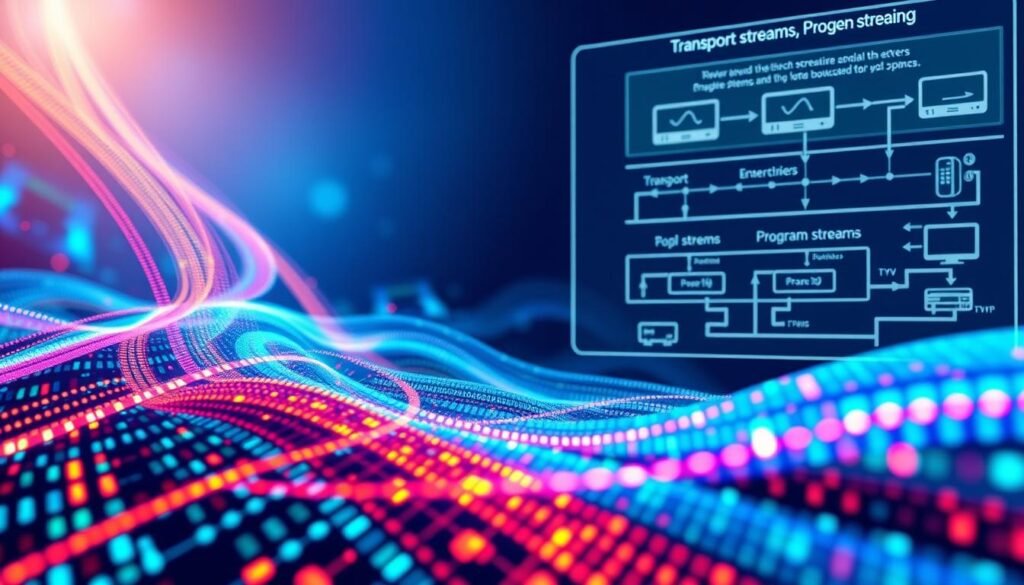
Understanding the difference between transport streams and program streams is key in digital media. Both use stream multiplexing for audio and video. But they serve different needs.
Knowing the technical differences is vital for quality delivery. The wrong choice can cause playback problems or data loss.
Definition and Purpose
Program streams are for storing on stable media like hard drives or optical discs. They have fewer overheads and are optimised for playback from files.
Transport streams, on the other hand, are for robustness. They’re made for transmission over noisy channels where data might get lost or corrupted. They use fixed-size packets for efficient recovery in tough network conditions.
Use Cases in Broadcasting
Transport streams excel in error correction. They’re the top choice for live broadcasting, satellite, and cable TV. Here, signal interference is a big risk.
Program streams are best for controlled settings like local video editing or archiving. In these places, the complex error correction in transport streams isn’t needed.
The table below shows the main differences between these two formats:
| Feature | Transport Stream | Program Stream |
|---|---|---|
| Primary Use | Live Transmission | Local Storage |
| Error Handling | High (Robust) | Low (Minimal) |
| Packet Size | Fixed (188 bytes) | Variable |
| Network Suitability | Excellent | Poor |
Key Standards and Regulations
Understanding UK broadcasting rules is key. Following these rules is a cornerstone for any digital broadcasting organisation. It ensures content is delivered well and on time.
Ofcom Guidelines
Ofcom is the main UK communications regulator. They set rules for transport streams to keep quality high. Broadcasters must check their signals to meet these standards.
Not following these rules can cause big problems. It’s important for teams to check their systems often. This keeps quality up and avoids trouble.
Industry Best Practices
Following industry best practices is also key. Keeping systems working well together is important. Many use tools to find and fix problems early.
Staying standardised helps share content smoothly. This avoids problems and keeps service quality high. Here’s where rules and best practices meet.
| Compliance Area | Regulatory Focus | Best Practice |
|---|---|---|
| Signal Integrity | Ofcom Standards | Automated Monitoring |
| Data Throughput | Bandwidth Limits | Efficient Compression |
| Interoperability | System Compatibility | Standardised Protocols |
| Service Availability | Public Access | Redundant Infrastructure |
Advantages of Using Transport Streams
Choosing the right delivery format is key for top-notch digital broadcasting. In the UK, broadcasters use transport streams to ensure content gets to viewers smoothly. This is true even when transmission conditions are tough.

Improved Quality of Service
This tech’s main perk is keeping Quality of Service consistent. It uses strong error correction to make sure data packets arrive in the right order. This is essential for live TV.
Good video compression is also key. It helps keep video quality high while using less bandwidth for media delivery. This balance is vital for meeting British viewers’ high standards.
Flexibility and Scalability
Broadcasters must adapt to changing viewer habits and tech needs. The flexibility of these streams makes it easy to add new channels or services as demand grows.
This scalability means networks can grow without a full system overhaul. By using advanced video compression, providers can scale their services affordably. They can keep performance high while keeping costs down.
| Feature | Benefit | Impact |
|---|---|---|
| Reliability | Error Correction | Stable media delivery |
| Efficiency | Data Packet Handling | Optimised bandwidth |
| Scalability | Modular Architecture | Easy channel growth |
Challenges Faced by Broadcasters
Broadcasters often face tough challenges when using transport streams in their networks. These systems are key for delivering content but can have technical issues. Keeping the viewing experience smooth requires constant effort and smart use of network resources.
Latency Issues
In live TV, every second matters. High latency can spoil the thrill of sports or breaking news, making viewers upset. When data packets are late, audio and video can get out of sync.
To solve this, engineers use advanced error correction methods. These help keep the stream stable, even when the network is not perfect. Without these, the broadcast quality could drop a lot.
Compatibility Problems
Many UK broadcasters struggle to mix new, IP-based systems with old hardware. Older gear can’t handle the complex transport streams of today. This can cause signal drops or even system failures.
To fix this, broadcasters need special technologies to help old devices work with new data packets. Good error correction is key during this time to avoid data loss. With careful planning, they can keep quality high while updating their systems.
Future Trends in Transport Streams
Innovation in transport streams is making our viewing experience better. The world of digital broadcasting is changing fast. Engineers are finding new ways to send high-quality content to all sorts of devices.
Advancements in Technology
Nowadays, workflows are moving to cloud-native systems. This means broadcasters can manage their streams better and save money.
Also, new video codecs like VVC are coming. They will make video streaming more efficient. This means you can watch high-definition content even when internet speeds are slow.
Impact of 5G on Broadcasting
5G technology is changing everything. It makes live digital broadcasting on mobile devices smooth and reliable.
With network slicing, providers can give video traffic its own special path. This keeps transport streams stable, even in busy cities where lots of people are using mobile data.
| Feature | Legacy Systems | Next-Gen Networks |
|---|---|---|
| Latency | High | Ultra-Low |
| Flexibility | Limited | High (Cloud-Native) |
| Mobile Delivery | Unstable | Optimised (5G) |
| Compression | MPEG-2 | VVC/HEVC |
Conclusion: The Importance of Understanding Transport Streams
Broadcasting technology is changing fast in the UK. To stay ahead, it’s key to understand how data moves in complex networks.
Summary of Essential Concepts
Good content delivery needs careful management of transport streams. These ensure audio and video stay in sync. Broadcasters who get this right offer a better viewing experience.
Strategic Outlook for UK Media
The industry is always changing with 5G and cloud solutions. Keeping up with these changes is vital. Learning about transport streams helps protect your systems from future problems.
Your focus on technical skill keeps British TV and radio leading globally. Stay updated with Ofcom news and new standards. This way, your content meets viewers’ high expectations every day.
